Use Case
ERP Migration & Multi-ERP Operations
ERP migrations and multi-ERP environments expose a fundamental weakness in traditional accounting architectures: the ERP is forced to be both the system of record and the system of detail.
Change ERPs without breaking accounting — or overwhelming them.
Links removes that constraint.
Challenges
The Pain — Before Links
ERP migrations are high-risk because accounting detail, logic, and history are tightly coupled to the ERP itself.
Before: ERP Change as a Financial Reset
- Ledger locked inside the ERP — accounting logic and history must be rebuilt during migration
- Transaction overload — operational detail floods the GL, degrading performance
- Parallel ERP chaos — inconsistent accounting across old and new systems
- Lost or archived detail — drill-back disappears once systems are retired
- Audit risk — broken lineage across ERP boundaries
- Big-bang cutovers — high risk, limited rollback, extended close cycles
Changing ERPs often means starting over — operationally, financially, and audit-wise.
Solution
How Links Solves These Pains
Links decouples financial truth from ERP infrastructure.
Instead of pushing every operational detail into the ERP, Links retains full-detail journals in its own ledger and submits summarized, controlled journals to one or more ERPs.
After: ERP Change Without Accounting Disruption
- Detailed subledger journals live permanently in Links
- ERPs receive lightweight, summarized postings
- Every ERP journal can be drilled back to:
- Detailed journals in Links
- The original operational transactions
- Multiple ERPs can operate in parallel using the same accounting logic
- ERP migrations become phased, reversible, and low risk
Your ERP becomes a reporting and control endpoint, not the bottleneck.
Why
Why This Matters to Finance
For the Office of the CFO, ERP migration is not a systems upgrade — it’s a continuity event.
Links gives Finance
- A persistent accounting system of record across ERP changes
- Clean, explainable journals without flooding the GL
- Consistent accounting treatment across regions and ERPs
- Confidence that audit trails survive migrations and acquisitions
For Controllers and Accounting teams
- No re-implementation of accounting rules
- No loss of journal detail after cutover
- No performance degradation from transactional overload
ERP flexibility becomes a strategic advantage, not a risk.
Architecture
How Links Enables ERP Migration & Multi-ERP
Links operates as an ERP-independent subledger and control plane.
Detail Journals Stay in Links
- All granular journal entries are recorded in Links ledgers
- Journals retain:
- Source transaction IDs
- Operational attributes
- Full accounting context
- Prevents flooding ERPs with operational detail
Control Accounts Bridge Subledger and ERP
Links uses control accounts to keep ERPs clean and reconcilable.
ERP journals stay light, fast, and explainable.
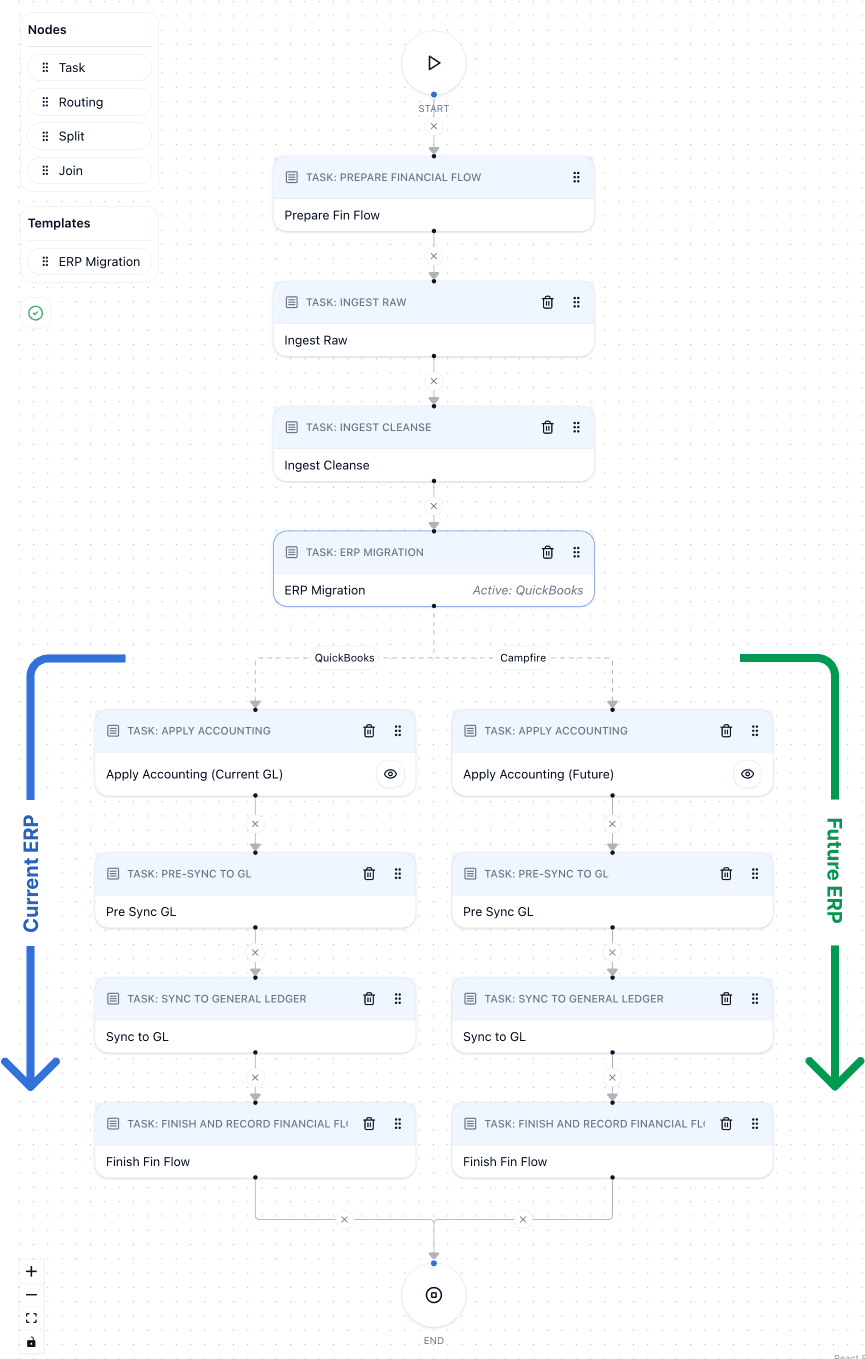
Deliver to One or Many ERPs
Links can:
- Post summarized journals to one ERP
- Post to multiple ERPs simultaneously
- Use pre-built “Migrate” button to effectively switch from one ERP to another ERP
Impact
Outcome Metrics Finance Teams Care About
Organizations using Links during ERP change consistently achieve:
Zero loss of journal detail
during ERP migrations
70%+ reduction
in ERP journal volume
No increase in close time
during migration periods
Lower audit risk
with continuous drill-back capability
Accelerated integration
Faster post-acquisition integration
Lower ERP migration cost
due to reduced rework
Summary
From ERP Lock-In to Financial Continuity
Before Links, ERP migrations meant rebuilding accounting from scratch.
With Links:
- Detail stays intact
- ERPs stay lightweight
- Accounting logic stays consistent
- Audit trails stay intact
Modern finance requires ERP flexibility. Links delivers ERP independence.
See how Links enables ERP migration and multi-ERP operations without losing detail or control.
More use cases
- Unified AccountingOne source of financial truth. Every system. No rebuilds.
- Continuous Reconciliation for Faster CloseClose in days, not weeks — without surprises. Or, close daily if you want it.
- Real-time AnalyticsToday's number today, not last week’s spreadsheets.
- Agentic Finance AIBoost teams productivity, meet your companies AI strategy.
- Post M&A Integration (PMI)Integrate faster. Preserve control. Never lose financial history.